Less than one and a half kilometres (15 minutes’ walk) from the villa there is a small square in Ražanj with the Studenac and Ribola shops selling groceries, toiletries and other small goods, a fruit and vegetable market, a bakery and an ATM. Route from the villa to the centre.
Every day in the high season, a van selling fresh fish pulls up in front of the apartments, and another one sells bread and pastries. Don’t be put off by the Croatian shouting – run out and see what’s on offer.
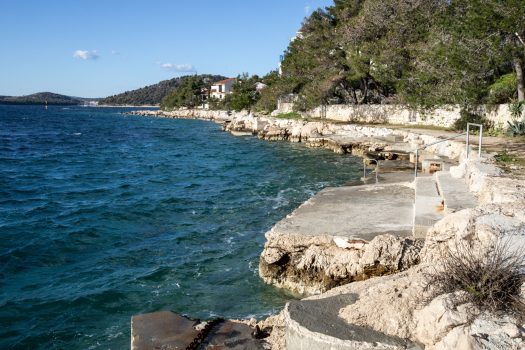
It is a 20-minute walk to the local Ražanj beach, but by bike or scooter you will be there in no time! Guests also recommend the beach in Kanica, about 10 minutes away by car, or the pebble beaches in Rogoznica, Primošten and Trogir.
Punta Planka – the windy cape
Don’t miss the sunset view from the windy cape of Punta Planka with its medieval chapel. It is accessible via a coastal path for cyclists and walkers. Before you go, you can check the current weather on the Live webcam Punta Planka.
By sea to Rogoznica – boat taxi
If you are looking for a bit more action, visit the neighbouring town of Rogoznica. The quickest way there is across the sea! Two so-called boat taxi lines run once in the morning and then every half hour from 4:00 p.m., taking you to the town centre in 20 minutes for a small fee.
Rogoznica is a typical seaside resort with a bustling promenade full of cafés and restaurants, attractions for children and souvenirs, as well as a beautiful harbour with an endless parade of yachts. Also worth a visit are the salt lake Zmajevo oko (Dragon’s Eye), which is always warmer than the sea, the lavender labyrinth, and the local landmark, the Church of the Assumption of the Virgin Mary.
Trips in the area
Trogir
The locals call Trogir “little Venice“. It is regarded as a true museum of medieval architecture. Trogir has a rich history, and today it benefits not only from its past but also from the natural beauty it shows to visitors.
The historic town centre is a UNESCO World Heritage Site and is considered one of the best-preserved medieval towns in the Mediterranean. Stroll through the narrow streets and admire the Gothic and Renaissance palaces and beautiful churches.
You reach the historic core via a “small” stone bridge, which connects the mainland part of Trogir with the old town and is a symbol of the city.
Split
Split, one of the most beautiful cities in Croatia, attracts thousands of visitors every year with its rich history and stunning natural scenery. Its most important monument is Diocletian’s Palace, built in the 4th century and still considered one of the greatest Roman buildings. It is a UNESCO World Heritage Site. The city’s landmark is the bell tower, one of the best places to visit, which you will find inside Diocletian’s Palace.
Also worth mentioning are the harbour Riva promenade, the heart of the city, and the wooded Marjan hill above Split, which offers amazing views of the city and the sea. The best-known and most popular sandy beach in Split is Bačvice.
Primošten
Primošten lies on two small peninsulas, one of which holds an old picturesque village famous for its narrow streets and traditional rural buildings. The village got its name from its connection to the mainland by a bridge (primošten = connected by a bridge). Its landmark is the 15th-century Church of St. George, which was enlarged and rebuilt in the 18th century.
The second peninsula, Raduča, is mainly given over to tourism: you will find dozens of places to stay, restaurants, sports and leisure grounds and an indoor swimming pool. This makes Primošten one of the most popular Croatian holiday resorts.
Primošten is dominated by the world’s largest monument to Our Lady of Loreto. It is 17 metres high and stands on Gaj hill in front of Primošten. The romantic summer views from the monument are definitely worth it!
Šibenik
Šibenik is a paradise for lovers of historical monuments. It lies about 35 km from Ražanj on the Šibenik Bay, where the Krka River flows into the Adriatic Sea. Šibenik is connected to the open sea by the narrow and deep St. Anthony Channel.
If you love underwater life, don’t miss the aquarium, where you can see many kinds of fish and sea creatures that live in the Adriatic.
Another attraction near Šibenik is Aquapark Dalmatia – find out more at aquapark-dalmatia.com.
Krka National Park
If you are spending your holiday on the Dalmatian part of the Adriatic coast, don’t miss the most powerful waterfalls, the so-called Skradin waterfalls (Skradinski buk), which are truly impressive. They lie on the Krka, the most remarkable karst river in Dalmatia.
The water cascades over 17 travertine terraces in a system of cascades and waterfalls, dropping a total of 37.5 m at an average flow of 55 m3 per second. The waterfalls are a magnificent sight all year round, but they are at their most powerful in late spring when the water level is highest (thanks to its underground and surface sources, the Krka has plenty of water all year). Although the Skradin waterfalls alone are worth a visit, they are only a small part of what the Krka River has to offer. The river is 72.5 km long from its source near Knin to its mouth at Šibenik. The national park covers almost its entire course from Nečvengrad to the Šibenik Bay. In places the river forms a narrow, deep limestone canyon with walls up to 200 m high.
The ancient town of Skradin, once the Illyrian-Roman Sardona, is also worth a short stop, with plenty of opportunities to taste local specialities – for example the local 1 cm long fish “golac”, grilled.